
Spring in Northeast Ohio is the moment most homeowners finally walk into the backyard and ask the same question: what’s worth fixing first? Budgets aren’t unlimited, and a great-looking yard depends on getting two very different categories of work right — softscape and hardscape. Pick the wrong one to start with and you’ll either spend a season staring at thin grass around a beautiful patio, or pour money into garden beds that wash out the next time a Lake Erie storm rolls through.
This guide cuts through it. Here’s exactly how to decide which to upgrade first, why the order matters, and where the budget should really go on properties across Cuyahoga, Lake, and Summit counties.
Softscape vs. Hardscape: The Quick Definition
Hardscape is everything in your yard that doesn’t grow. Think patios, walkways, retaining walls, paver driveways, fire pits, pergolas, outdoor kitchens, and drainage systems. It’s the bones of the property.
Softscape is the living part — lawn, trees, shrubs, perennials, annual flowers, mulch beds, and ground cover. It’s what makes the yard feel like a yard instead of a parking lot.
A great landscape design uses both. They’re not in competition; they’re partners. The real question isn’t which is better — it’s which one to fix first when you can’t do everything at once.
The Rule That Decides It: Hardscape First, Softscape Second
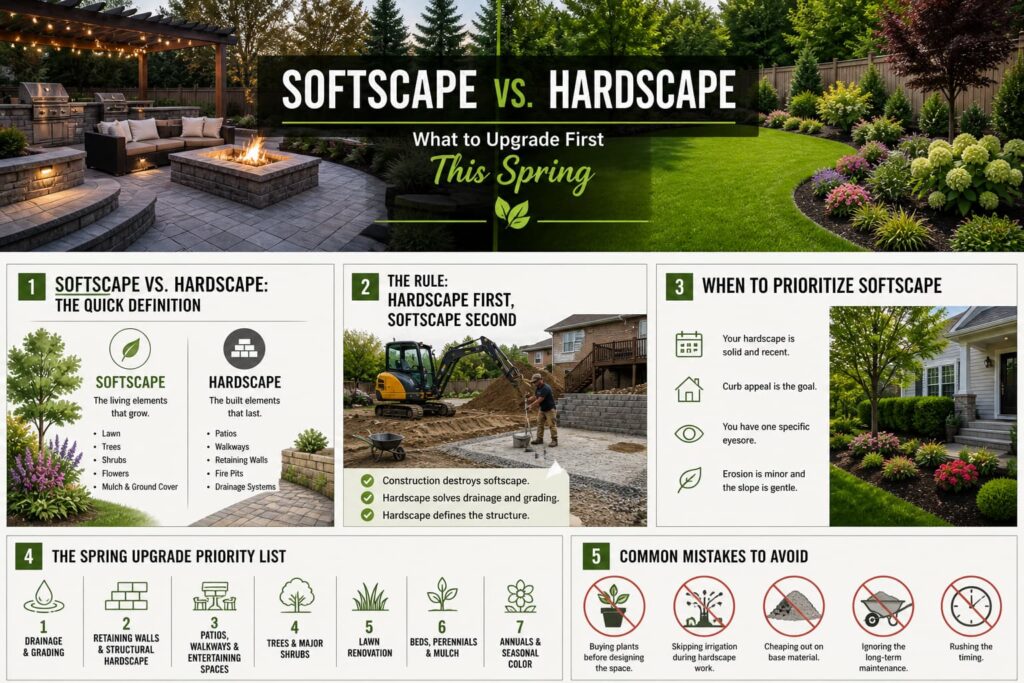
If you’re starting from a yard that needs serious work, hardscape almost always comes first. There are three reasons, and they’re not opinions:
1. Hardscape construction destroys softscape. Building a patio, retaining wall, or walkway means heavy equipment, excavation, and material staging. If you’ve already laid sod, planted shrubs, or installed a sprinkler system, expect a chunk of it to be torn up. Doing the lawn first and the patio second is how people end up paying for the lawn twice.
2. Hardscape solves drainage and grading. Most yard problems homeowners blame on plants are actually grading and drainage problems. Standing water, eroded beds, soggy lawn patches — these get fixed when retaining walls, French drains, and proper hardscape grading go in. Plant on top of bad drainage and you’re just buying compost for next year’s mud. This is especially true in Northeast Ohio, where heavy clay soils and freeze-thaw cycles make poor drainage twice as punishing.
3. Hardscape defines the structure. You can’t intelligently choose plants until you know where the patio ends, where the path runs, and where the retaining wall holds back the slope. Softscape is the finish coat. Hardscape is the canvas.
The exception: if your hardscape is already in good shape and the only thing dragging the property down is a thin lawn or overgrown beds, skip ahead. You don’t need to tear up a perfectly good patio to justify a softscape upgrade.
When to Prioritize Softscape This Spring
There are real cases where softscape should jump to the front of the line:
- Your hardscape is solid and recent. Patios under 10 years old in good condition don’t need replacing. Spend the money on plants, lawn, and beds.
- Curb appeal is the goal. If you’re listing the house or hosting a major event, fresh sod, mulch, and a clean bed line move the needle faster — and cheaper — than any hardscape project.
- You have one specific eyesore. A dying tree, a bare patch from last summer’s drought, an overgrown foundation planting — fix the eyesore. Don’t redesign the whole yard.
- Erosion is minor and the slope is gentle. Ground cover and deep-rooted plantings can handle light erosion. If water is actively cutting channels through your beds, that’s a hardscape job (drainage, retaining walls) not a softscape job.
The Spring Upgrade Priority List
Working with a real budget, here’s the order that makes sense for most properties:
1. Drainage and grading. Boring, invisible, and the highest-ROI work you can do. If water pools near your foundation or runs across the lawn after every rain, fix this first or everything else you build sits on top of a problem.
2. Retaining walls and structural hardscape. If a slope is failing or a wall is leaning, this is non-negotiable. Walls fail slowly and then all at once.
3. Patios, walkways, and entertaining spaces. This is where most people overspend on softscape and underspend on hardscape. A well-built paver patio adds usable square footage to your home for 20+ years. Annuals last six months.
4. Trees and major shrubs. Trees are a 30-year decision. Plant them after the hardscape is in so you don’t dig them up later, but before you fuss over flower beds.
5. Lawn renovation. Aeration, overseeding, sod replacement. Spring or fall — fall is actually better for the cool-season grasses common in Ohio, but spring works if your lawn has bare patches you can’t live with for another six months.
6. Beds, perennials, and mulch. The finish coat. Cheap to refresh, high visual impact, and easy to change next year if you don’t love it.
7. Annuals and seasonal color. Fun, but treat it as decorating, not landscaping. It shouldn’t be the first line item in a serious upgrade budget.
Common Mistakes Homeowners Make in Spring
A few patterns we see every year:
- Buying plants before designing the space. A trip to the garden center in April leads to a trunk full of impulse purchases that don’t fit the yard. Plan first, shop second.
- Skipping irrigation during hardscape work. If you’re already trenching for a patio or wall, run irrigation lines and conduit at the same time. Adding them later means cutting the new patio.
- Cheaping out on base material. A patio is only as good as the four to six inches of compacted gravel underneath it. Pavers laid on bare dirt heave and shift within two seasons. There’s no fixing this without rebuilding.
- Mulching over a drainage problem. Mulch hides the symptom. The water is still there.
- Planting shade-loving plants in a yard that’s about to lose a tree. If a tree is coming down or being limbed up significantly, wait on the understory plantings until you know what light conditions you actually have.
How to Budget the Decision
A useful split for a full landscape renovation: roughly 60-70% hardscape, 30-40% softscape. Hardscape costs more per square foot, lasts longer, and carries more of the design. If your quotes are coming in flipped — heavy on plants, light on structure — that’s a sign the design is leaning on softscape to do work that hardscape should be doing.
If you’re only doing a refresh, the split flips: most of the budget goes to softscape, because the hardscape is already there.
Where to Start
The honest answer: walk the property after a hard rain. Note where water sits, where soil has washed out, where the lawn turns to mud, and where the existing hardscape is cracked, sunken, or missing. That walk tells you whether you have a hardscape problem dressed up as a plant problem, or a genuinely cosmetic refresh.
If it’s the former, fix the bones first. If it’s the latter, spring is a great time to plant.
Ready to figure out what your yard actually needs this spring? Request a consultation with the BruZiv Landscaping team and we’ll walk the property with you. Learn more about our residential landscaping services, custom hardscape design, and full-service landscape design and installation. You can also browse recent work in our Northeast Ohio project portfolio, or see what’s trending this year in our Top 5 Hardscape Design Trends for 2025.
FAQ
Is hardscape or softscape more expensive? Hardscape costs more per square foot up front but lasts decades. Softscape is cheaper to install but needs ongoing replacement and maintenance. Over a 20-year horizon, well-built hardscape is usually the better dollar-per-year value.
Can I install hardscape and softscape at the same time? Yes, and it’s the most efficient way to do a full renovation — one mobilization, one design, no rework. The sequencing within the project still matters: hardscape goes in first, then irrigation, then plants and lawn.
What’s the worst time of year to install a patio in Northeast Ohio? Mid-winter when the ground is frozen, and the wettest stretches of early spring when sites are too saturated to work. Late spring through fall is the sweet spot. Booking early gets you on the schedule before it fills up.
Do I need a permit for hardscape work? Often yes – especially for retaining walls over a certain height, drainage tied into municipal systems, and any structure with footings. Permit requirements vary across Cuyahoga, Lake, and Summit county municipalities. A reputable contractor will handle this. Don’t skip it; unpermitted work becomes your problem when you sell the house.
Does BruZiv handle both the hardscape and softscape sides of a project? Yes. The team includes hardscape, softscape, and low-voltage lighting specialists, so a full design/build can be coordinated under one crew rather than juggling subcontractors. Learn more on the About page.